- Shehr Yar
- PEP medication
-
October 15, 2026
If you landed on this page, you’re probably not looking for general information. You’re looking for a straight answer to something that happened — last night, this morning, maybe a few hours ago — and you want to know what to do about it right now, not after reading ten paragraphs of background.
So here it is, first, before anything else: if there’s any chance you were exposed to HIV in the last 72 hours — a condom broke, slipped, came off, wasn’t used, or the encounter was otherwise unprotected — a medication called PEP (Post-Exposure Prophylaxis) can very likely still help you, but only if it’s started quickly. It is a prescription-only emergency treatment in the UAE, available through a licensed doctor, not something you can buy over the counter or online. The good news: getting that doctor to you — anywhere in Dubai, Abu Dhabi, Sharjah, or elsewhere in the Emirates — can happen within the hour, from home, without a hospital queue.
That’s what the rest of this page walks through: what counts as a risk, how PEP actually works, what Life Aid’s process looks like, and the honest answers to the questions people in your exact situation are asking right now.
“I Made a Mistake” — You’re Not the First Person to Search This Tonight
However it happened — a one-night stand, a moment with someone whose status you don’t know, a slip after a few drinks, a decision you wouldn’t normally make — the reason doesn’t change what happens next, and it doesn’t need explaining to anyone. What matters clinically is one thing: when did it happen, and has it been under 72 hours?
If yes, you still have time. If you’re not sure, assume you do and reach out immediately — every hour that passes narrows the window in which PEP works best. Life Aid Home Health Care is a DHA-licensed home healthcare provider (License No. 7767040) that can send a healthcare professional and arrange a doctor’s assessment at your home, hotel, or office anywhere in the UAE — Dubai, Abu Dhabi, Sharjah, Ajman, and beyond — usually within 20 to 25 minutes of first contact.
Condom Broke, Slipped, or Came Off — Does That Actually Put You at Risk?
Yes, a broken, slipped, or displaced condom is one of the most common reasons people reach out for PEP, and it’s taken seriously for good reason — even a brief failure, for a minute or less, is enough exposure time for risk to exist. Whether it happened in Dubai, Abu Dhabi, or anywhere else in the UAE, the clinical response is the same: a doctor needs to assess the specifics — what kind of contact occurred, for how long, and whether the condom was replaced — and decide whether PEP is warranted.
A few specific versions of this we hear constantly, all of which deserve the same answer — get assessed, don’t guess:
- The condom broke or slipped off partway through, and a new one was put on. Even a short gap without protection is still an exposure window a doctor needs to evaluate.
- The condom came off and stayed inside a partner during intercourse.
- It was “protected,” but with someone whose HIV status is completely unknown — protection reduces risk, it doesn’t erase the need for assessment when something unexpected happens.
- Sex with a sex worker where the condom broke mid-encounter — this is treated as a standard risk assessment, with full confidentiality and zero judgment, the same as any other scenario.
In every one of these, the honest answer is the same: you don’t need to diagnose your own risk level from a search engine. A doctor does that in minutes, at your home, and either reassures you or starts you on PEP the same day.
What Is the Emergency HIV Prevention Medication Available in the UAE?
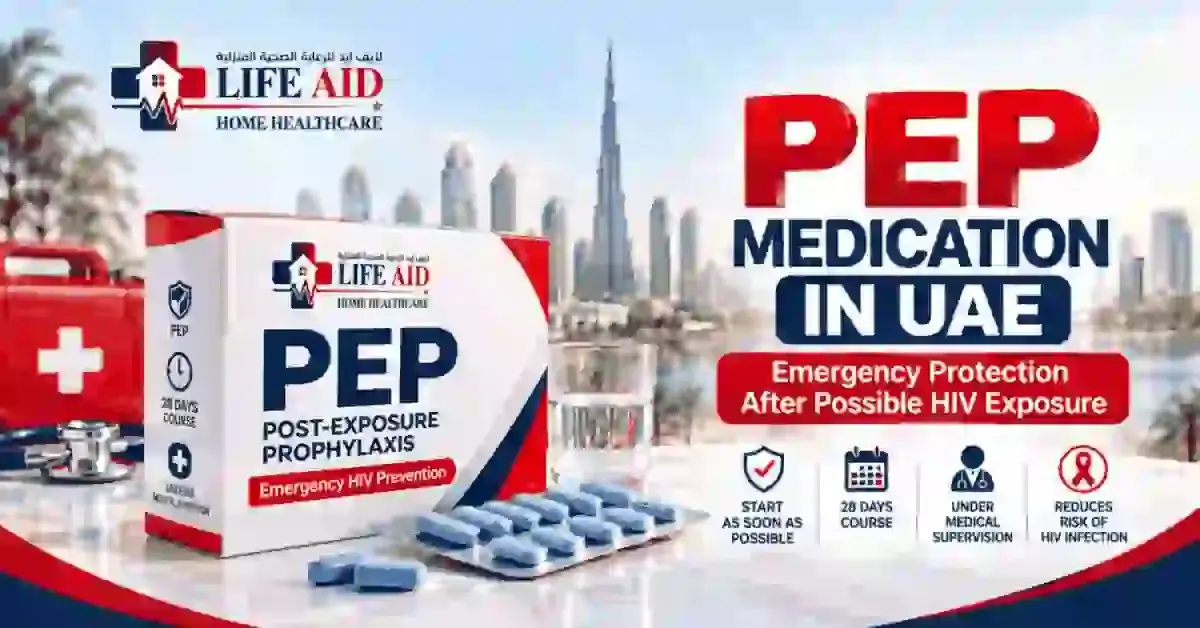
PEP (Post-Exposure Prophylaxis) is the emergency medication used across the UAE to prevent HIV from establishing itself in the body after a possible exposure. It is a short course of antiretroviral tablets — not an injection, not a one-time pill, and not available as a vaccine or implant. Currently, there is no injectable or injection-based option for PEP anywhere, including in Dubai and Abu Dhabi — it is strictly an oral tablet regimen, taken once daily for 28 days.
PEP works by flooding your system with a combination of medications that interrupt HIV at multiple stages of early infection, before the virus has a chance to establish a permanent foothold in your immune cells. It is legally classified as a prescription-only, controlled medication in the UAE — you cannot buy it over the counter, in a regular pharmacy without a script, or online. Only a DHA-licensed or MOH-accredited doctor can assess you and prescribe it, which is exactly the gap Life Aid is built to close quickly and privately.
The 72-Hour Window: Why Timing Is the Only Thing That Matters Right Now
This is the single most important fact on this entire page, so it’s worth stating plainly: PEP must be started within 72 hours of a possible exposure, and it works best the sooner it’s started.
Here’s how effectiveness actually tracks with time, based on how the medication works biologically:
| Time Since Exposure | What This Means for You |
| Within 24 hours | The strongest window. Starting this early gives PEP the best possible chance to stop the virus before it replicates. |
| 24–48 hours | Still highly effective. Not too late at all — this is a normal, common window for people to start PEP, and it still works well. |
| 48–72 hours | The outer edge of the window. PEP can still be prescribed and is still worth taking, but there’s no time left to wait — same-day assessment is essential. |
| Past 72 hours | Doctors generally will not prescribe PEP, because there’s no longer reliable evidence it prevents infection. (See the section below on what to do instead.) |
So to directly answer the specific versions of this question people ask most: no, taking PEP at 24 hours is not “too early” or ineffective — it’s actually the ideal window. And no, 48 hours is not too late — it’s a completely normal and valid time to start, as long as you move quickly. What you should never do is wait to “see if symptoms appear” or decide it’s “probably fine” — by the time any symptoms would show up, the window for PEP has already closed.
Wherever you are in the UAE — Dubai, Abu Dhabi, or elsewhere — Life Aid can get a healthcare professional to you quickly enough to make the 72-hour window work in your favor, with same-day doctor assessment and testing available every day of the week.
Does the Type of Sex Change Your Risk? Here’s What Actually Matters
People searching this almost always want one specific thing: to know whether their exact scenario counts as “risky enough” to justify reaching out. The honest clinical answer is that risk varies by the type of contact and your role in it, but when there’s genuine uncertainty, assessment costs you nothing and protects you completely.
Here’s a general breakdown doctors use when evaluating exposure risk, from relatively lower to higher risk:
- Receptive anal sex without protection — this carries one of the higher transmission risk profiles of any single sexual act, because of how exposure occurs. If this describes what happened, you should treat it as a priority and reach out immediately rather than waiting to see how you feel.
- Insertive anal sex with a condom failure — also a meaningful risk category, and one a doctor will assess the same way regardless of which role you were in.
- Unprotected vaginal sex, receptive or insertive — a well-established risk category that regularly leads to PEP being prescribed, especially when the partner’s status is unknown.
- Oral sex — generally carries a lower risk than anal or vaginal sex, but it is not zero, and specific factors raise it: giving oral sex to a partner of unknown HIV status, particularly with ejaculation, or receiving oral sex when you have cuts, sores, or bleeding gums in your mouth, both increase the actual exposure risk beyond baseline.
Whether the contact was receptive or insertive, with or without ejaculation, protected with a failure or fully unprotected — all of these are variables a doctor weighs together, not something you need to score yourself. If you’re a man who has sex with men and had a high-risk encounter, the same urgency applies as above: don’t wait, reach out the same day, and let the assessment — not a search result — tell you what you actually need.
Was It Non-Consensual? PEP Is a Priority, No Exceptions
If you were sexually assaulted, taking PEP is treated as medically mandatory, not optional, provided you’re within the 72-hour window. This is one of the clearest-cut scenarios in emergency HIV prevention, and it comes with the same full confidentiality as every other assessment Life Aid provides — no judgment, no unnecessary questions, just immediate care.
Where Can You Actually Get PEP, Right Now, Anywhere in the UAE?
PEP is not sold over the counter anywhere in the UAE, and no legitimate provider will tell you otherwise — it is a controlled medication available only through a DHA-licensed or MOH-accredited healthcare facility. That’s a meaningfully stricter system than what you might be used to from the US, Ireland, Canada, or elsewhere, where access can look different. In the UAE, it means the medication is limited to a smaller number of accredited facilities — which is exactly why knowing the fastest legitimate route matters more here than almost anywhere else.
A hospital is one option, and it will get you seen — but it often means waiting in a queue, going through standard intake protocol, and losing time you may not have to spare. For many people, that trade-off isn’t worth it when a faster, equally legitimate, and far more private alternative exists.
Here’s exactly how the Life Aid process works, anywhere in the UAE:
- You reach out immediately — by phone, WhatsApp, or through the website. No waiting room, no explaining yourself to a stranger at a front desk. Just tell us roughly what happened and when.
- A healthcare professional is dispatched to you — to your home, hotel, or office, typically within 20–25 minutes, anywhere across Dubai, Abu Dhabi, Sharjah, and the wider UAE.
- A licensed doctor assesses your exposure — the type of contact, timing, and risk factors, either in person or via a connected consultation, to confirm whether PEP is appropriate.
- Baseline testing is carried out on the spot, if the doctor determines it’s needed (details below), with results typically ready in a matter of hours, not days.
- PEP is prescribed, if appropriate, the same day — with full guidance on the 28-day course, what to expect, and how to take it correctly.
- Follow-up is coordinated for you — including the testing you’ll need at the end of the course, so nothing falls through the cracks.
This is, functionally, the answer to “emergency HIV doctor on call” — because that’s exactly what this process delivers: a licensed doctor, reachable around the clock, who can reach you anywhere in the UAE rather than the other way around.
Do You Need Tests Before Starting PEP?
Yes — once you contact a healthcare professional, a baseline panel is typically run before (or alongside) starting PEP, so your doctor has a full clinical picture. This usually includes:
- HIV 1 & 2 P24 Combo (Antigen & Antibody) test
- Hepatitis B
- Hepatitis C
- Syphilis
- Chlamydia
- Gonorrhea
- Ureaplasma parvum and urealyticum
- Kidney function profile
- Liver function profile
Your exact prescription and medication choice depends on these results — which is precisely why self-assessing from home and trying to source medication without this step is never medically sound, whatever a website might imply is possible.
What Does a Full PEP Regimen Actually Contain, and Why?
For complete protection, a PEP regimen needs two things working together: a “backbone” that blocks the virus from building its structural components, and a “core” drug that stops any virus that gets past the backbone from inserting itself into your immune cells’ DNA. This is why PEP is never a single medication — it’s a combination, functioning like layered security rather than one lock on one door.
Based on current clinical standards referenced internationally, here’s how the regimens break down:
| Regimen Type | What It Contains | How It’s Usually Taken |
| Single-tablet regimen (preferred, gold standard) | Bictegravir / Emtricitabine / Tenofovir Alafenamide — commonly known by the brand Biktarvy | One pill, once a day. Favored because a single tablet removes any confusion around multiple medications and timings. |
| Two-pill regimen | An integrase inhibitor such as Dolutegravir (brand Tivicay), combined with a backbone of Emtricitabine/Tenofovir — either Truvada (TDF-based) or Descovy (TAF-based) | Two pills, once a day. |
| Alternative: Raltegravir-based | Raltegravir (brand Isentress) combined with a Truvada or Descovy backbone | Often requires the Raltegravir portion twice daily, which means a higher overall pill count. Used when first-line options aren’t suitable. |
| Alternative: Protease-inhibitor-based | Darunavir with Cobicistat or Ritonavir, combined with a Truvada or Descovy backbone (an all-in-one combination is marketed as Symtuza) | Used less often today, typically reserved for specific medical circumstances, as this category carries a higher likelihood of gastrointestinal side effects. |
Which of these you’re prescribed depends entirely on your baseline test results, any existing health conditions (like kidney function), other medications you’re on, and what’s available at the time — not personal preference. This is also the clinical answer to “what meds do I take after a one-night stand” — the medication is chosen for you, by a doctor, based on your specific profile, not selected off a shelf.
Why three drugs instead of two?
A two-drug combination leaves a gap: if the virus manages to get past the first layer of defense, there’s nothing left to stop it from integrating into your cells. The third drug — the integrase inhibitor — closes that gap. It’s the reason PEP regimens are built the way they are: even if the strain you were exposed to turns out to be resistant to one component, the other two are there specifically to compensate, which is also the direct answer to whether PEP can still work against a potentially drug-resistant strain. It’s designed with exactly that uncertainty in mind.
Taking PEP: What to Expect Over the 28 Days
PEP is taken as one pill (or your prescribed combination) once a day, at the same time every day, for 28 consecutive days. Consistency matters as much as starting on time.
Side effects are generally mild and well-tolerated with modern regimens, most noticeable in the first one to two weeks:
- Nausea, mild stomach discomfort, gas, or diarrhea — the most common complaints
- Fatigue or feeling unusually drained
- Mild to moderate headaches, usually manageable with standard over-the-counter relief
- Vivid dreams or disrupted sleep, particularly with Dolutegravir-containing regimens
Rules worth following closely while on the course:
- Never skip or delay a dose — take it at the same time daily.
- If you miss a dose by a few hours, take it as soon as you remember.
- If you miss it by a day, or your next dose is close, skip the missed one and resume your normal schedule. Never double up to compensate.
- Space PEP two hours before or six hours after antacids or supplements containing aluminum, magnesium, calcium, or iron — these can interfere with absorption.
- Limit alcohol and stay well hydrated throughout the course.
- Practice safe sex and avoid sharing needles or blood for the full 28 days, until your final HIV-negative result is confirmed.
Importantly, PEP does not weaken or harm your immune system — it protects your defense cells and blocks the virus from replicating in your blood, it does not suppress anything your body already relies on.
What If It’s Already Been More Than 72 Hours?
If the 72-hour window has passed, PEP is generally no longer prescribed, because by that point the virus has typically had enough time to attempt to establish itself within CD4 and CD8 immune cells, and there’s no reliable evidence PEP still helps at that stage. No medication offers 100% certainty against HIV outside that window — there is no pill that reverses time.
What your doctor can still do is set up a clear testing timeline to get you a definitive answer as early and accurately as possible:
- Day 10–14: An HIV Early Detection RNA PCR test, which looks for the virus’s genetic material directly and can detect infection earlier than standard antibody-based tests.
- 4–6 weeks: A standard 4th Generation HIV Ag/Ab Combo test.
- 3 months: A final confirmatory test to conclusively establish your status.
This is also something Life Aid coordinates fully from home — there’s no reason to manage this testing timeline on your own, or to wonder which test to ask for at which stage.
What Tests Come After You Finish the PEP Course?
At the end of your 28-day course, your doctor will typically repeat an HIV 1 & 2 4th Generation test, along with a follow-up liver and kidney profile, to confirm the medication was well-tolerated and to check your status conclusively.
After PEP: How Do You Stay Protected Going Forward?
This is a question worth asking before you even finish your course, not after. PEP does not create lasting immunity. It is not a vaccine, and it does not leave behind any form of long-term protection. Once your 28-day course is complete, the medication clears your system within a few days, and your risk profile for any future exposure returns to exactly where it started — zero added protection.
If you’re someone who may face ongoing risk — not just a single incident — the logical next step your doctor may discuss is transitioning to PrEP (Pre-Exposure Prophylaxis) once your PEP course ends. PrEP is an ongoing daily medication that actively protects you before any future exposure happens, rather than reacting to one after the fact. We cover the full process for starting PrEP in the UAE in our separate guide: PrEP Medicine in Dubai.
Can You Take PEP More Than Once?
Yes. There is no biological or legal limit on how many times you can take PEP, and it can be prescribed again for separate, unrelated exposure events whenever genuinely needed. That said, doctors generally flag a few real considerations if PEP becomes a recurring pattern rather than an occasional emergency course:
- It is a demanding 28-day regimen to repeat often, and the cumulative effect on the body — including recurring stomach discomfort some people experience — is worth discussing with your doctor.
- Repeated PEP courses still leave gaps in your protection between each incident, since PEP offers no standing immunity.
- If you find yourself needing PEP more than once, that’s often the clearest practical sign that PrEP — ongoing, continuous protection — may genuinely serve you better than repeated emergency courses.
Your doctor will always be honest with you about this rather than just refilling the same prescription on repeat, because the goal is protecting you long-term, not just closing out one incident at a time.
However You Got Here Tonight — The Next Step Is the Same
Whatever brought you to this page — a condom that failed, a decision you’re second-guessing, an assault, a one-night stand, or simple precaution after an encounter with someone whose status you don’t know — the path forward doesn’t change: get assessed by a licensed doctor, quickly, privately, and without judgment.
Life Aid Home Health Care is a DHA-licensed home healthcare provider available across Dubai, Abu Dhabi, Sharjah, and the wider UAE, every day, to send a healthcare professional to you, arrange same-day doctor assessment, run baseline testing, and get you started on PEP — all from the privacy of your own home, hotel, or office.
Contact Life Aid now for a confidential PEP assessment anywhere in the UAE. DHA-licensed. Doctor-led. Same-day response, 24/7.
Medical disclaimer: This article is for general informational purposes and does not replace individual medical advice. PEP eligibility, testing requirements, medication selection, and treatment decisions are determined solely by a licensed physician following a proper clinical assessment. This content is intended for review by Life Aid’s medical team prior to publication. Brand and medication information referenced in this article (Biktarvy, Truvada, Descovy, Tivicay, Isentress, Symtuza) reflects publicly available manufacturer information and is provided for general awareness only — actual prescribing decisions are made solely by your assessing physician based on your individual health profile.
Related Post